
Eating Disorder Recovery when Food is Limited
This support becomes especially important when recovery is happening alongside food insecurity and when having enough to eat isn’t always a given. Many households go through cycles each month: a stretch of relative abundance after a paycheck or food assistance, followed by a period of scarcity as those resources run low.
In these moments, restriction can happen in many ways. Sometimes it’s involuntary, such as when there’s simply not enough food. Other times, it’s a choice made out of love and sacrifice, like a parent skipping meals so their children can eat. Regardless of the reason, research shows that food restriction can trigger the body’s survival response causing intense cravings, food preoccupation, and binge eating when food is available again.
These patterns don’t mean you’re failing; they’re a natural response to not having enough. But they can make recovery harder to sustain, especially in a world that often overlooks the impact of food insecurity on mental health.
If this is your experience, you’re not alone, and you’re not doing anything wrong. There is help, and there are resources that can support your recovery, even in the face of real and ongoing challenges.
Here are three ways to support your recovery while navigating food insecurity. These aren’t the only options, but they can be helpful starting points as you find what works for you.
Building Blocks Approach to Filling the Pantry
While there are many great food assistant programs, oftentimes a single program cannot offer enough food to sustain healthy eating long-term. For example, the federal SNAP program offers the average recipient only $6.20 per day—hardly enough to support three nutrient-rich meals, let alone to support someone working to return to health and their growth curve.
SNAP is a vital first step, but is strengthened significantly when combined with state and local food assistance, such as food pantries, supplemental produce programs, and community-based organizations. Layering resources can help provide a more consistent and reliable foundation to aid sustained recovery. At the end of this article, we provide a list of food assistance programs in Colorado and Denver to get started.
Create a Food Sustainability Plan
The structure of a once-a-month benefit like SNAP can unintentionally create a feast-or-famine cycle: plenty at the beginning of the month, but scarcity by the end. Once this pattern sets in, it can be hard to break.
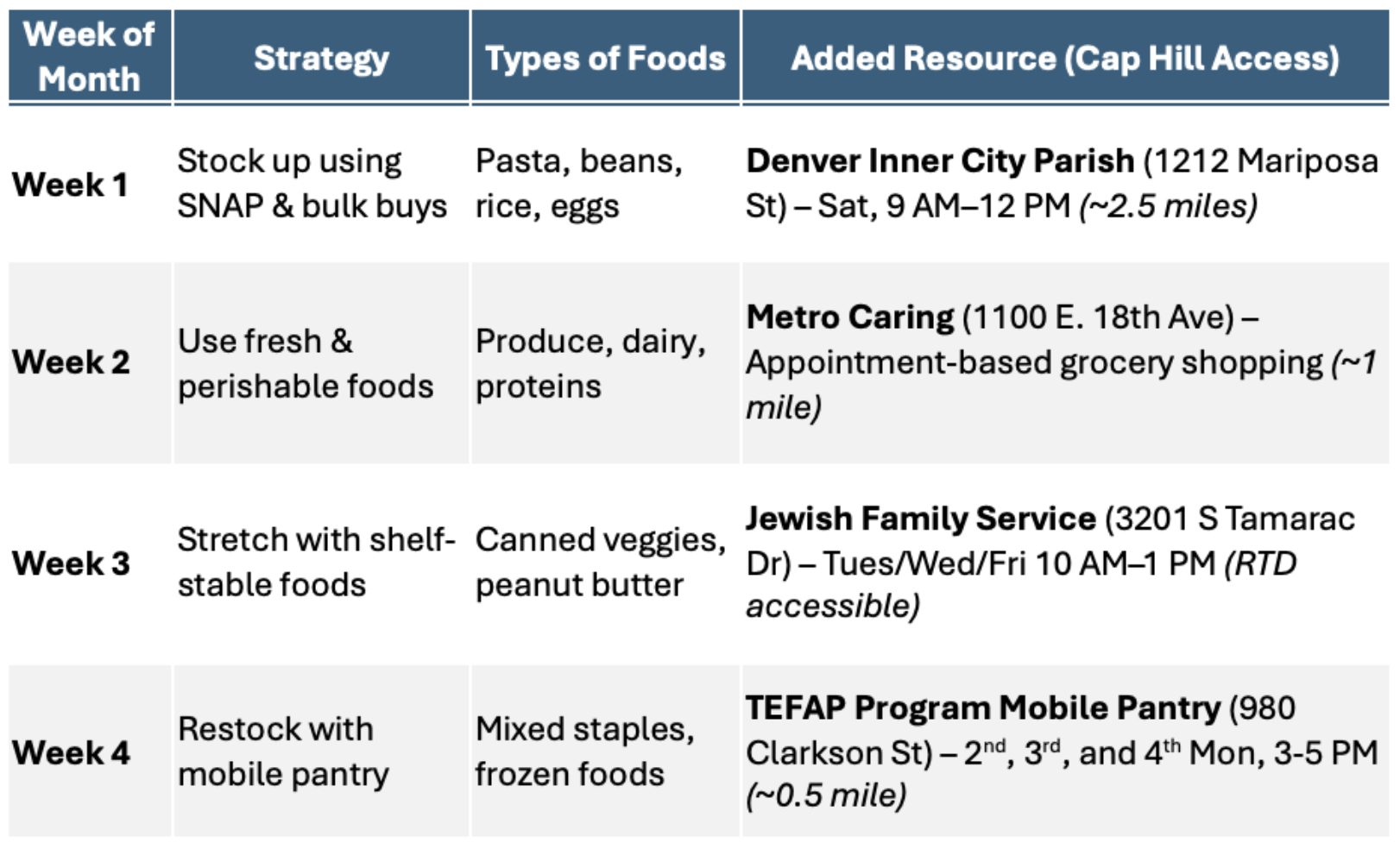
Creating a food sustainability plan means finding ways to spread the available resources as equally as possible across the course of the month in a way that’s realistic and sustainable. For example, this might include planning meals that include frozen produce or shelf-stable ingredients for later in the month, or identifying local pantries that distribute mid-cycle. The goal is not rigid control, but rather to extend food access in a way that nourishes continued recovery.
Below is a sample food sustainability calendar based on programs currently available near our Cap Hill Denver location as of July 2025.
Recruit Your Therapist as an Ally
If you’re seeing a therapist to support your recovery, let them know the specific barriers to treatment you’re encountering and ask them for help. Oftentimes therapists can provide additional resources, such as reduced cost therapy sessions via sliding scale models, referrals to local community partners, vouchers for free transportation to food pantries, or eating disorder recovery scholarships for higher levels of care.
At Better Life Therapy, we are constantly connecting with new providers, community resource groups, and referral partners, and we are able to provide clients with tailored resource lists upon request. Additionally, many of our therapists specialize in the treatment of eating disorders across a broad spectrum of lived experience. If you’re interested in learning more about available resources or connecting with one of our therapists, we would be honored to work with you. Reach out at betterlifetherapy.com/contact or call 720-445-9979.
Colorado Food Assistance Resources
SNAP (Supplemental Nutrition Assistance Program)
Federal monthly benefits via Colorado PEAK/MyCOBenefits; eligibility based on income.
Colorado SNAP Produce Bonus
Monthly dollar-for-dollar match (up to $60) on fresh produce purchases.
Food Bank of the Rockies Mobile Pantries
Monthly distributions across 32 counties (use locator to find nearby).
The Emergency Food Assistance Program (TEFAP)
Monthly food box for income-eligible adults.
Hunger Free Colorado Hotline
Call 855.855.4626.
Denver Food Assistance Resources
Jewish Family Service – Weinberg Pantry
Available up to 2×/month: Tues, Wed, Fri 10 AM–1 PM; plus last Wed of month 4-7 PM.
Denver Inner City Parish (DICP)
Weekly pantry plus five mobile pop-ups; clients select food; mobile sites operate monthly.
Bienvenidos Food Bank
Monthly mobile pantries in targeted neighborhoods (e.g. West Colfax).
Metro Caring – Fresh Foods Market
Free monthly appointment-based grocery shopping.